Counterparts - Ammani House 28 in transition

March 7th, 2010

Rainbow street house 28 amman
Photo: Dina Haddadin

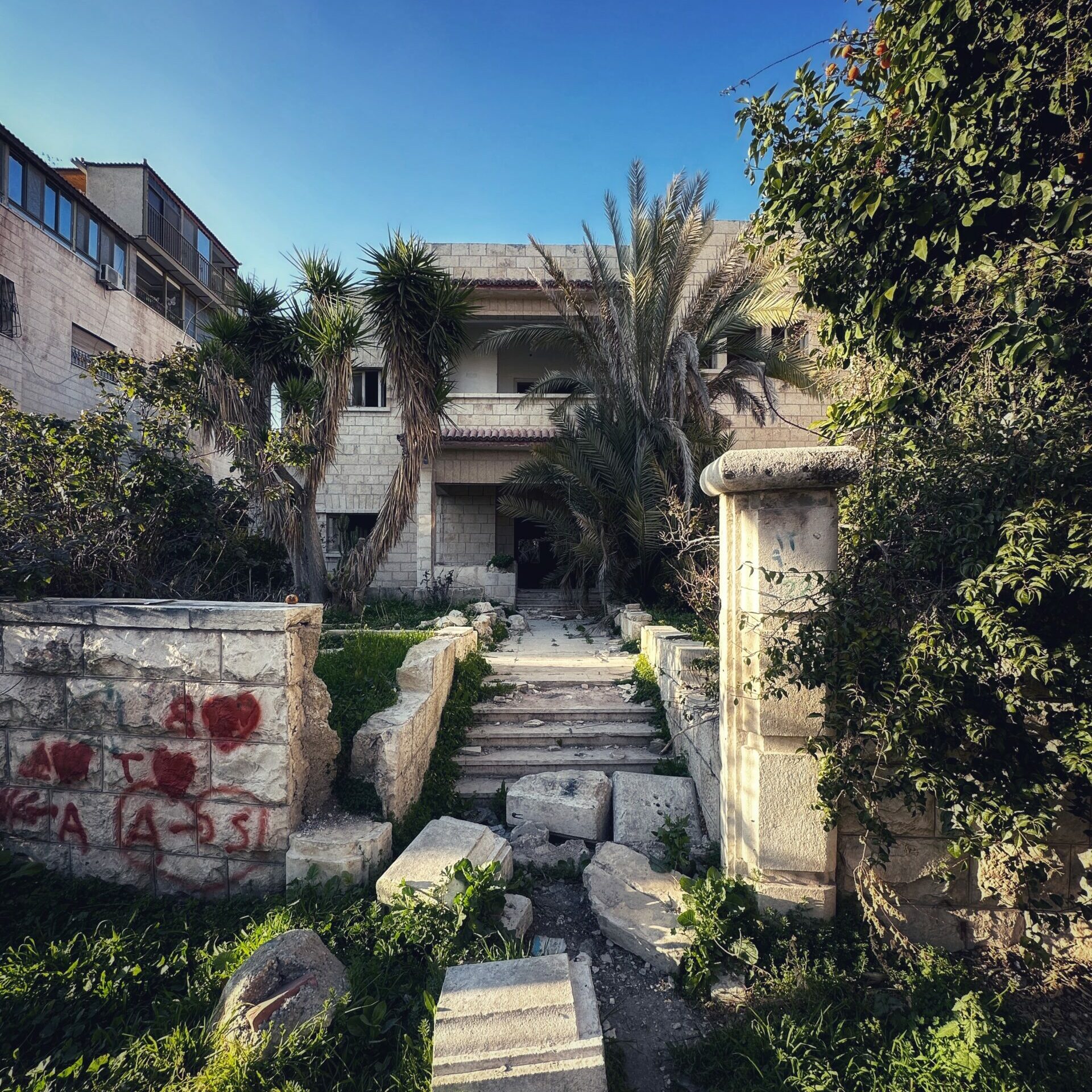
House 28 on the corner of Rainbow Street is in a state of flux.

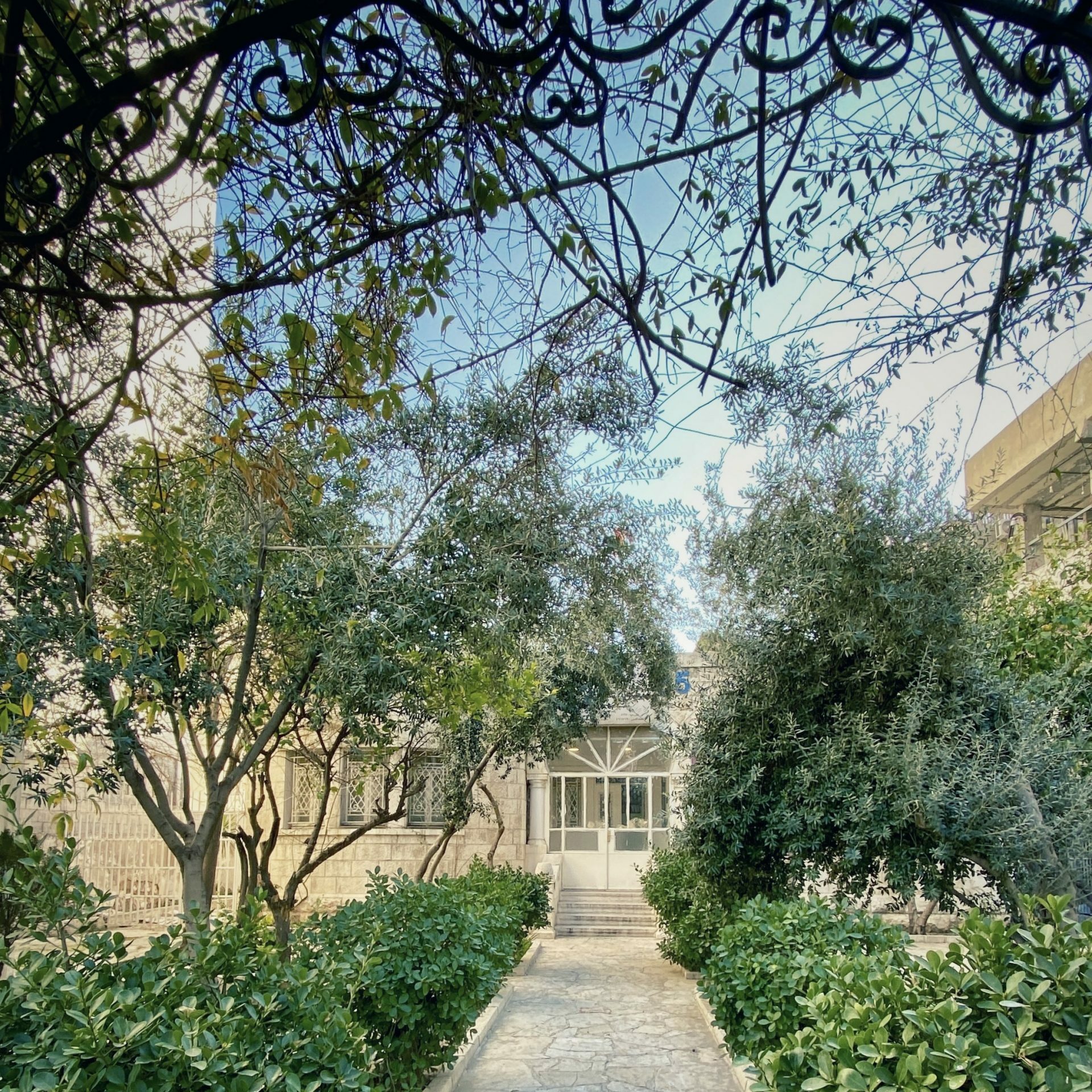
The old landlady and her old, bed-ridden husband have passed away. It seems like yesterday she was showing Ahmad Sabbagh and me through the apartment under the main house. That apartment became what I called the “SYNTAX house”. A succession of SYNTAX’s German Bauhaus design interns lived there over the past four years, anchored by couple of Jordanian SYNTAXers: Sabbagh and “Ibra” Oweiss.

The SYNTAX house at one point became the Blouzaat house, as the Blouzaat cross cultural urban art project was born there, complete with a silkscreening workshop in the shed, which stands at the end of the wild garden that stretched in front of the apartment.

This house was already in transformation when Sabbagh found it. For some strange reason, the terrace in front of the apartment was covered with the elaborate tiling typical of older Levantine houses, pointing to the fact that the terrace maybe was a series of rooms at one point.

A very rudimentary metal staircase connected the lower apartment to the upper terrace of the main house, clearly a later, cheaply done, addition.

A blue metal garden gate, more fitting to a workshop.

Like many of Jabal Amman’s houses, this property has something grand about it. A reminder of what I can only guess must’ve been better times. The architectural decay of the house reflected the withering existence of the house’s owners. There is something sad about that neighborhood and such houses, despite the attention they recently attracted through Rainbow’s renewal project. It is a sense of discontinuity. A decline of stature. No new generation to take over the property and keep it alive. Its sadness that perhaps invites re-interpretation.

Now, house 28, with its old landlords gone and its young tenants dispersed again, is getting a new life. It will be converted to a restaurant by one of Amman’s most prominent restauranteurs and restorers of old houses, Zeid Goussous.

Counterparts Amman

But the house’s transformation from residential to commercial has been “interrupted” by a couple of its former tenants (the Blouzat team aka Sabbagh and Typism, or whatever they call themselves at the moment) the people from Interruptions magazine (that’s Khaled Sedki and his ever-shifting “crew”) and architect artist Dina Haddadin, with support from Makan.
Goussous “lent” them the house to make “Counterparts” happen: an art project of painting and installations that will run from 6 March to 20 March 2010.

I drove home yesterday after the well attended opening night with a few bad snapshots on my mobile and a positive inner feeling. A feeling I often get after having spent some time with people in that part of town. For me its not so much about the art itself (although I really liked the work on display) and definitely not about the intellectual muscle flexing in the accompanying texts (they lost me at “Nietzsche’s hammer” :-)

For me it is about the connections created. People to people. People to places. Houses reborn.

Go see it.

Counterpoints amman art installation

Counterpoints amman art installation

Read these related posts on 360east:

  • Think (very) Small: Tiny houses
  • When underprivilged/female Jordan teaches the privileged/male Jordan a lesson
  • Two faces of Ammani villa architecture
  • Bookmark this post on your favorite bookmarking service

    del.icio.us:Counterparts - Ammani House 28 in transition digg:Counterparts - Ammani House 28 in transition newsvine:Counterparts - Ammani House 28 in transition furl:Counterparts - Ammani House 28 in transition reddit:Counterparts - Ammani House 28 in transition Y!:Counterparts - Ammani House 28 in transition

    The iPad is so 2010. Say “hello?” to the ePad..

    March 6th, 2010

    Read these related posts on 360east:

  • After the dust settled.. some iPad questions
  • Say Happy New 2010 on Amman’s 1st Cricle tomorrow
  • 360east goes to Mobile World Congress 2010
  • Bookmark this post on your favorite bookmarking service

    del.icio.us:The iPad is so 2010. Say  digg:The iPad is so 2010. Say  newsvine:The iPad is so 2010. Say  furl:The iPad is so 2010. Say  reddit:The iPad is so 2010. Say  Y!:The iPad is so 2010. Say

    The NYTimess writes about Amman (and my fellow bloggers and tweeps complain)

    March 1st, 2010

    I really love my fellow Ammani bloggers and tweeps. I really think that they are one of the best things that happened to us in the last ten years. I love that many of them have give a voice to Amman’s urban issues and urban activism. But sometimes they have me shaking my head with puzzlement.
    Like when the New York Times recently published a story on Amman’s newly improved sidewalks (as in Wakalat Street and Rainbow Street and elsewhere) and the sprouting of an “identity” in the city.

    The article mentions improvements in the eastern and western parts of Amman. It recognizes that the new Amman master plan consciously wants to avoid Amman’s “Dubai-ification”. It talks to people like Gerry Post from the Amman Institute and Rami Daher, one of Amman’s best urban historians and the architect behind Rainbow’s rehabilitation, as well as a number of ordinary citizens. It talks about how new sidewalks and benches are re-introducing Ammanis to the concept of an inclusive public space. It also focuses on the issues around Wakalat Street’s pedestrianization (and some of the negative reactions of high-end apparel merchants there).

    All in all, in my opinion, a pretty good article about some of the positive improvements in Amman, while also noting that the city still suffers from an identity challenge.

    Alone, the fact that an article tackling Amman’s urban identity is being published on the NYTimes’ web site should be a reason to celebrate. I mean, finally the world is taking note of Amman as an urban destination and issue, not just simply a boring place (as it has largely been treated by the foreign media which is only impressed by “exotic” and “oriental” cities like Damascus and Cairo).

    But a handful of my blogging and tweeting friends (both Jordanians and Westerners) seem to be unhappy or even somehow offended by the article.

    “Condescending”, “Reeks of Municipality and Amman Institute PR”, “Stereotypes” are some of the words they’ve been using on Twitter. For one blogger, the article’s biggest sin was that it made it seem as if Amman is only now developing an identity. “Did you really think the article is good,” asked another good blogging friend of mine, when she saw me retweeting the link to the article.

    Well..

    Let’s just remind ourselves of a few facts..

    Our sidewalks not only suck, they suck big time. Saying so is not condescension but merely stating a fact. I’ve written on this blog some years ago that Amman should win an award for worst sidewalks in the world and no one said I was being condescending. A Lebanese writer recently noted how he found himself as “Amman’s only pedestrian” which meant Ammanis forgot how to walk. I think we need to hear this a million times more: Amman’s sidewalks are a disaster. Thank you NYTimes for noting some of the improvements that were made in various place.

    OK, what about identity?

    Maybe the NYTimes’ writers went too far by saying that Amman is “bereft of an identity”. Amman has an identity. But, if anything, Amman it is a “weak” identity. And, yes, this is me saying this (Mr. Amman Brand). Does anyone want to argue that Amman’s identity is as strong as Cairo’s or Las Vegas’? Yes, we always had a very interesting identity: one that was build on the city’s openness which resulted in an interesting, always emerging human collage. We have our hills and views and white stones and stairs. But let’s be realistic. In literature and music, in food and drink, in self-awareness and historical awareness, Amman is just now coming to terms with its identity. The NYTImes article correctly points out that hardly anyone calls him or herself “Ammani”. We have a long way to go when it comes to fleshing out our urban identity.
    Friends: this is a city whose public transport and public spaces have been neglected for decades. Only now do we have a city management that thinks this stuff is really important. Amman is a place where many prominent families had no problem demolishing their old family houses to replace them with ugly commercial buildings. Amman is a city that was under the real threat of being punctured by a dozen glass skyscrapers from the 8th to the 3rd circle. It’s a city where large private villas and large cars continue to set the agenda and where sidewalks are mostly mere decoration and not places for walking.

    One of the best people who has written about Amman deeply and academically is the Jordanian anthropologist Seteney Shami. Her work served as one of the foundations our team at SYNTAX depended on when we worked on the Amman Brand. One of the key texts she has written about Amman is entitled “Amman is not a city”. This title does not mean that Shami thinks that Amman is not a city. Rather, it is about her digging behind the sociopolitical reasons that cause Amman’s residents to underestimate (and undermine) their city’s “citiness”.

    So, while I am a Amman optimist, I still favor facing the harsh reality of our city’s weak sense of identity.

    In any case: a short article for a Western audience in a mainstream media outlet like the NYTImes cannot be expected to delve into the minute details of Amman’s urban identity. It might not cover all the issue. Our newfound enthusiasm for Amman should not mask the fact that there is still a long, hard journey before Amman to evolve and celebrate its urban identity.

    Lastly, I think our city needs people to work together to push things forward. We should work together for one simple reason: Taken together, the people with “good ideas” or “sensitivity” for Amman are outnumbered. Whatever urban progress we have made so far, can easily be rolled back by the forces of unthinking commerce and uncultured bureaucracy.

    People will not agree on everything and might have conflicting agendas and interests in a city like Amman. Spirited bloggers and activists will always be more aggressive in pushing for more reforms and more inclusiveness. City officials’ priorities might differ on some of the issues. My personal view is that there are enough areas of potential overlap, cooperation and fruitful dialogue. Previous city administrations where forcing massive changes that where detrimental to the city’s urban identity and heritage without much opposition from anyone. Now that GAM pays more attention to public space, public transport and city identity, I believe that constructive dialogue and joint action are in order.

    Read these related posts on 360east:

  • Toot announces Top 10 bloggers for January 2006
  • Amman explosions: Jordan’s bloggers react
  • A Lebanese man walks in Amman..
  • Bookmark this post on your favorite bookmarking service

    del.icio.us:The NYTimess writes about Amman (and my fellow bloggers and tweeps complain) digg:The NYTimess writes about Amman (and my fellow bloggers and tweeps complain) newsvine:The NYTimess writes about Amman (and my fellow bloggers and tweeps complain) furl:The NYTimess writes about Amman (and my fellow bloggers and tweeps complain) reddit:The NYTimess writes about Amman (and my fellow bloggers and tweeps complain) Y!:The NYTimess writes about Amman (and my fellow bloggers and tweeps complain)

    Who can revolutionize Arabic music? A bunch of people from Finland and their friends, perhaps?

    February 27th, 2010

    I really wish I had a time machine in my basement. Here is what I would do: pay a visit to Cairo in the 1950s or 1960s. Here is one time destination I would travel to: 24 February 1966, Cairo. I would key-in time and place on the machine’s touch screen and seconds later would be walking in Cairo University, near a building that houses one of the university’s large halls. If I could sneak myself in the building I would see President Jamal Abel Nasser as he arrives to attend a concert by Umm Kulthoum, who was scheduled to sing ‘Amal Hayati’ on the occasion of Police Day. Now I am not an Umm Kulthom fan but it would be cool to see this legendary Arab diva live, while also being in the same room with the enigmatic Abdel Nasser. But my main purpose would be to get up on the stage and tell Umm Kulthoum, the President and the audience something:

    “You will not believe this, but I just travelled to you from the future.. from the year 2010. This song that you have just performed my dear lady, in fact, all your songs and tens of thousands of other Arabic songs from the past and the future will, in 54 years, be available for listening and purchase through little phones that millions of people carry with them.. like walkie talkies. And guess what? There will be a commercial company that will make this possible. And that company will be from Finland. Today that company produces rubber boots”.

    At that point, security agents will probably storm the stage. I would press a button on my time’s machines small remote control in my pocket and be zipped back to the present. Phew..

    That rubber boot company is Nokia.

    A company that is absolutely hell bent on fighting for its prominent position in the mobile market. A company that is absolutely resolute about being relevant to people around the world by being totally local.

    And what is more local than a culture’s songs and music?

    What Arab internet companies have failed to do so far, Finnish Nokia has just accomplished: creating the largest Arabic digital music store and working on putting it in the hands of millions of Arab consumers. It has launched its ‘Comes with Music’ initiative in 11 new Arab markets recently in a glitzy Beirut event to which I was invited (along with a huge contingent of Arab journalists and bloggers). These countries are Egypt, Lebanon, Jordan, Palestinian Territories, Iraq, Saudi Arabia, the United Arab Emirates, Kuwait, Qatar, Bahrain, and Oman.

    And here is how our friends from Finland intend to revolutionize the Arab music market.

    They will release a touchscreen phone (Nokia’s first with capacitive screen by the way) called the X6. When you by that phone in the mentioned Arab countries you will have access to a music store of 4 million tracks, including “tens of thousands” of Arabic songs. And get this: you will be able to download as many songs as you like during a one year period and keep them forever.

    Think about it: just in a few days, you will be able to legitimately download every song you have in your current music collection (imagine: all you current CDs, your old tapes if you are as old as me, and all the pirated MP3 you have on your hard disk). Then, you could start downloading all the albums of your favorite artists that you still don’t own. Then you could spend the rest of the year exploring all kinds of new and old music, potentially downloading thousands and thousands of songs!

    It’s pretty crazy. But true.

    Nokia Comes with Music event in Beirut

    Now the bad news: this “Comes with Music” thing will, initially, be only available on the X6, a US$ 600 smart phone. Nokia say that other phones will follow.

    The music will be DRM protected. Which means it will only play on one PC (also, no Mac support yet) and your phone.

    And, for now, you will not be able to buy music “a la carte” (as Nokia people like to say) if you don’t have a Comes with Music phone.

    Still this is one hell of an interesting strategy to approach the Arab market with. This store has virtually no serious competitor. Apple doesn’t care about this market and the iTunes Music Store can’t be used with credit cards with billing addresses in the region. It’s a market where music piracy is rampant and old style music retail (selling legit CDs and before that tapes) is weak. I remember going to downtown Amman in the 1980s and it was dotted with “tape stores” who almost exclusively sold pirated tapes by the truckload. Not exactly a great situation for artists and music companies.

    Nokia is really serious about this. When I talked to their music label relations guy Raby Hamza in Beirut, he confirmed that they talked to all the major music companies in the region, and also to smaller alternative labels, like Lebanon’s Incognito, which is one of the better known distributers of new, alternative forms of Arabic music form the Levant and Egypt. And although Nokia is not as far as Apple’s iTunes is when it comes to enabling independent artists to easily sell their music online, the company already works with so called “aggregators” of music form smaller independent labels worldwide. So it could be possible that, in the coming years, a bunch of guys in a garage band in Zarqa or a teenage girl with amazing vocal talents in Saudi will be able to sell their music on the Nokia music store and build an online following instead of going through big corporate labels.

    So instead of coming to the market with a complicated proposition and per track pricing, Nokia has opted to hit big, with an all you can eat model to test the waters.

    Nokia X6
    The Nokia brand is trusted by young an old in the Arab region. And while someone like myself would not find the service attractive (1.DRM, 2. No Mac support, 3. it’s highly unlikely I will buy the X6), the all-you-can-eat proposition, especially if made available on more affordable devices, might, for the first time, create a pan-Arab digital music market, with a comprehensive catalogue and accessible to the Arab mainstream.

    And although all of this is driven by commerce and a quest to sell more mobile phones, the cultural implications are potentially big. Will making music become a way to make a living for more young Arabs? Will this music store (an the inevitable competitors who will follow) affect the development of Arabic music and singing itself, by enabling people to discover new emerging genres of Arabic musical expression?

    Music is a critical embodiment of culture. So besides the commercial significance of digital music distribution initiatives such as Nokia’s, it is also intriguing to ponder the fact that a Finnish global company (with a large team of Arabs in the region, of course) is bringing this about. Hence my wish to time travel half a century back to inform the pioneers of contemporary Arabic song about what will be!

    Nokia's Ayman Shalhoub announces Comes with Music
    Nokia’s Ayman Shalhoub announces “Comes with Music” on the Music Hall stage in Beirut

    Read these related posts on 360east:

  • MixUp Arabia episode 8 | Nov 3, 2005 | The Eid Cast!
  • Amman culture snapshot: (barely) catching Aziz Maraka
  • Will a Spiral Frog be the iTunes killer?
  • Bookmark this post on your favorite bookmarking service

    del.icio.us:Who can revolutionize Arabic music? A bunch of people from Finland and their friends, perhaps? digg:Who can revolutionize Arabic music? A bunch of people from Finland and their friends, perhaps? newsvine:Who can revolutionize Arabic music? A bunch of people from Finland and their friends, perhaps? furl:Who can revolutionize Arabic music? A bunch of people from Finland and their friends, perhaps? reddit:Who can revolutionize Arabic music? A bunch of people from Finland and their friends, perhaps? Y!:Who can revolutionize Arabic music? A bunch of people from Finland and their friends, perhaps?

    VIDEO: Zaha Hadid announced as winner to design new art and culture center in Amman

    February 24th, 2010

    Zaha Hadid was officially announced as the final winner of the long standing competition to design the King Abdullah II House for Art and culture in Amman. Mayor Omar Maani made the announcement in a special ceremony held a couple of days ago where he hosted Hadid and a group of dignitaries, cultural officials and local architects.

    Watch the video of Zaha’s presentation and the ensuing Q&A session. Sorry about the sound quality. If you’re really keen on this video, use headphones :-)

    Part 1: Zaha Hadi present previous work and Amman project

    Part2: Q&A

    Read my July 2008 post on this project here.

    Read these related posts on 360east:

  • Zaha Hadid didn’t show ..
  • Say goodbye to the ‘Factory of Smoke’. Say hello to Amman’s Opera House
  • International Design Forum: Arabia’s design Big Bang?
  • Bookmark this post on your favorite bookmarking service

    del.icio.us:VIDEO: Zaha Hadid announced as winner to design new art and culture center in Amman digg:VIDEO: Zaha Hadid announced as winner to design new art and culture center in Amman newsvine:VIDEO: Zaha Hadid announced as winner to design new art and culture center in Amman furl:VIDEO: Zaha Hadid announced as winner to design new art and culture center in Amman reddit:VIDEO: Zaha Hadid announced as winner to design new art and culture center in Amman Y!:VIDEO: Zaha Hadid announced as winner to design new art and culture center in Amman

    SYNTAX wins Jordan’s best website prize at the Jordan Web Awards

    February 22nd, 2010

    Check this out: the sweat and tears (almost) that the SYNTAX (and Spring) team poured into the Amman Centennial website paid off in a new way. It was a nice surprise that we won the Jordan Web Awards best site of 2009 prize.

    But there’s a catch: the trophy was so damn heavy, my arm almost fell off by the time I was out of the hotel lobby. It felt more like a punishment at that point! And we have to give it to the winner of next year’s winner (it’s like the world cup). Damn!

    Read more on SYNTAX’s Gold and Silver wins on the SYNTAX:CONTEXT blog.

    Read these related posts on 360east:

  • SYNTAX and Toot win at Jordan’s ‘Web Oscars’
  • SYNTAX looking for super talented managerial staff
  • Paul Krugman wins economics Nobel Prize (and proves he can be funny too!)
  • Bookmark this post on your favorite bookmarking service

    del.icio.us:SYNTAX wins Jordan's best website prize at the Jordan Web Awards digg:SYNTAX wins Jordan's best website prize at the Jordan Web Awards newsvine:SYNTAX wins Jordan's best website prize at the Jordan Web Awards furl:SYNTAX wins Jordan's best website prize at the Jordan Web Awards reddit:SYNTAX wins Jordan's best website prize at the Jordan Web Awards Y!:SYNTAX wins Jordan's best website prize at the Jordan Web Awards

    How to swear in Arabic, using web and tech jargon!

    February 22nd, 2010

    This video, the product of the “sick minds” at Kharabeesh was first shown at the Jordan Web Awards a couple of days ago. It was one of the highlights of the evening! So watch or I will RSS your face!

    Read these related posts on 360east:

  • Facebook goes Arabic..
  • Kick-starting tech entrepreneurship at Princess Sumaya University
  • Toot gets Pulped
  • Bookmark this post on your favorite bookmarking service

    del.icio.us:How to swear in Arabic, using web and tech jargon! digg:How to swear in Arabic, using web and tech jargon! newsvine:How to swear in Arabic, using web and tech jargon! furl:How to swear in Arabic, using web and tech jargon! reddit:How to swear in Arabic, using web and tech jargon! Y!:How to swear in Arabic, using web and tech jargon!